The Gallon Man’s latest guidance on squeezing every inch out of a compact campervan has sparked a fresh wave of “tiny‑but‑tough” projects across the hobbyist community. By swapping traditional layouts for modular, multipurpose fixtures, he demonstrates that a 2015 VW Caddy Maxi can feel more like a well‑organised studio than a cramped shoebox—provided builders accept a few trade‑offs and set realistic expectations from the outset.
Why “small” deserves a fresh mindset
Most DIY van‑builders start with a checklist of must‑haves—sleeping berth, kitchen, and storage—then try to jam them into the limited cubic footage. The Gallon Man flips that script: instead of adding more items, he asks builders to question each item’s true utility and to redesign it for dual purpose. This “less‑is‑more” philosophy reduces weight, lowers fuel consumption, and leaves room for unexpected comforts like a fold‑out workbench.
Modular furniture as the backbone of flexibility
Modularity is the single most effective lever for small‑space efficiency. A removable kitchen slab that doubles as a dining table, for instance, can be bolted to the van’s side rails with quick‑release pins. When not in use, the slab folds flat against the wall, exposing a hidden shelf for gear. The Gallon Man recommends using lightweight marine‑grade plywood (12 mm thick) and stainless‑steel hardware to keep the system robust yet easy to re‑configure during a weekend road trip.
Practical checklist
- Standardise mounting points. Pre‑drill a grid of 3‑inch holes along the sidewalls; every future module will slot into the same pattern.
- Integrate hidden hinges. Concealed hinges allow panels to fold flush, preserving interior aesthetics while providing a secret storage cavity.
- Plan for weight distribution. Place heavier modules (e.g., water tank) near the van’s centre of gravity to maintain handling.
Real‑world proof: the 2015 VW Caddy Maxi conversion
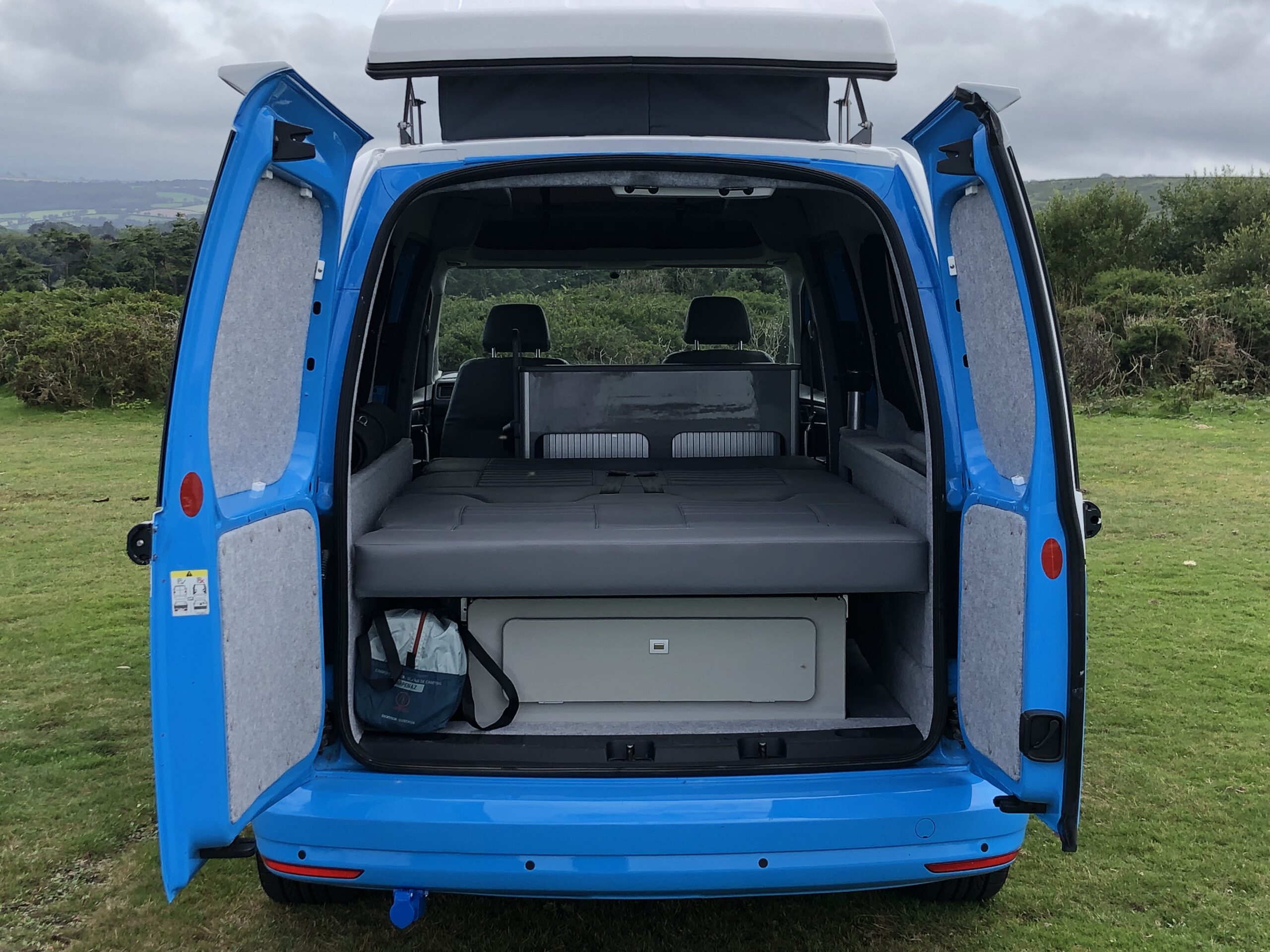
This particular Caddy Maxi, recently finished by a crew of seasoned van‑tinkerers, embodies the Gallon Man’s principles. The rear bench folds into a low‑profile bed, while a custom‑cut alcove beneath houses a portable fridge, a set of collapsible cookware, and a roll‑up solar panel. By routing the electrical harness through a central conduit, the builders avoided the spaghetti‑mess that usually clutters under‑floor panels. The result is a vehicle that feels spacious enough for two adults on a weekend getaway, yet still conforms to the original payload limits.
Trade‑offs you’ll encounter
Every gain comes with a cost. Modular systems, while flexible, demand precision engineering; a misaligned bracket can render a whole section unusable. Additionally, the reliance on lightweight materials may reduce durability under harsh weather unless treated with proper sealants. Builders must also accept that some comforts—like a full‑size fridge—will be swapped for portable alternatives to preserve space.
Setting realistic expectations before you start
Experienced hobbyists often underestimate the time required for mock‑ups. The Gallon Man advises a full‑scale cardboard prototype before cutting any wood. This cheap rehearsal reveals hidden clearance issues—like a door that swings into a mounted shelf—before they become costly mistakes. Moreover, budget for contingency: high‑quality hinges and custom brackets typically run 20‑30 % above off‑the‑shelf equivalents.
Implications for the broader DIY community
Adopting the Gallon Man’s unconventional wisdom could shift the DIY van market toward more adaptable, resale‑friendly builds. A modular interior is easier to strip out, making the van attractive to future owners who may have different priorities. As more hobbyists share their success stories, the collective knowledge base expands, lowering the barrier for newcomers who once thought “small space” meant “compromise”.